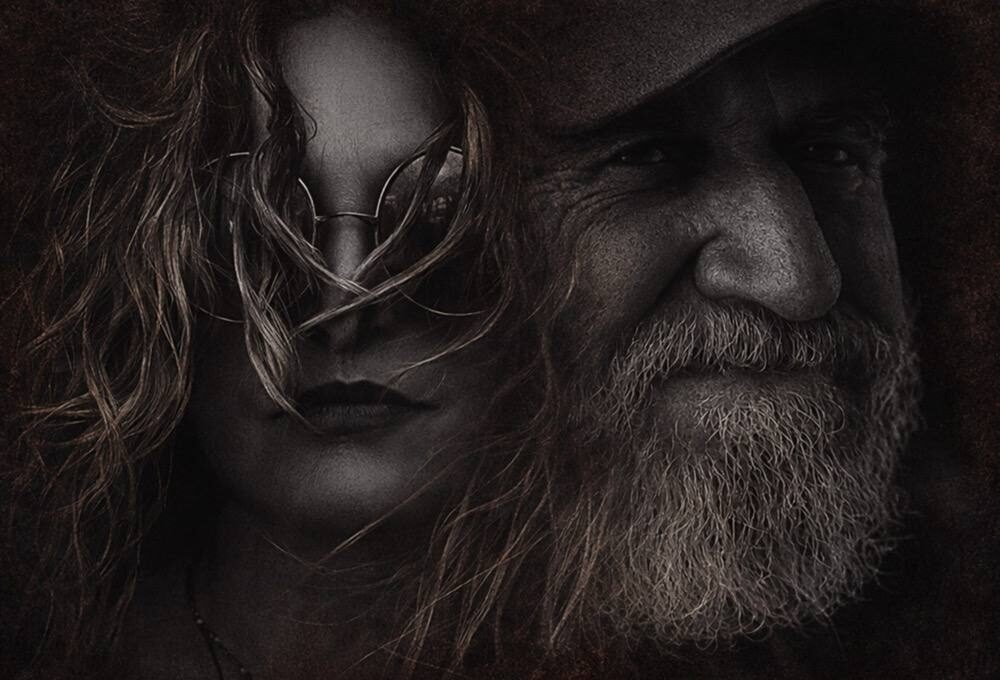
There’s a point somewhere along the line where classic rock stopped being a living, breathing thing and became a museum exhibit. Too many contemporary bands treat the genre like an exercise in replication—copy the riffs, add some analog warmth, toss in a vintage amp, and hope nostalgia does the heavy lifting. Thankfully, Eleyet McConnell understand something far more important: classic rock was never really about sound alone. It was about conviction.
That’s what drives The Journey, the duo’s sophomore album and easily their most ambitious, emotionally complete work to date.
From the opening moments, Angie and Chris McConnell make it clear they’re aiming for something bigger than retro homage. Yes, the record wears its influences proudly—there are shades of Led Zeppelin in the album’s muscular guitar work, traces of Small Faces in its bluesy swagger, and moments of spacious introspection recalling Radiohead at their most restrained—but The Journey never feels trapped by its inspirations.
Instead, it feels lived-in.
At the center of the record is Angie McConnell, whose vocal performances consistently elevate the material beyond straightforward rock craftsmanship. She possesses the kind of voice that sounds shaped by experience rather than technique alone. At times, there are flashes of Heart’s Ann Wilson in the sheer force of her delivery, while elsewhere the emotional rawness recalls Janis Joplin without ever slipping into imitation. There’s grit, vulnerability, and a refusal to sand down the rough edges.
That roughness works in the album’s favour.
Take “The Ledge,” one of the record’s standout moments. Built around themes of manipulation, emotional exhaustion, and liberation, the track unfolds with simmering tension before erupting into a cathartic chorus. The song’s central refrain—“Standing on the edge of the ledge / I need to break free from here”—lands with real emotional weight because the band allows the song to breathe rather than rushing toward the payoff.
Elsewhere, The Journey reveals surprising depth and range. “The Horizon” pulses with determination and forward momentum, while “King of Glass” examines illusion and self-destruction through sharp lyrical imagery and layered instrumentation. “Without You” offers one of the album’s most vulnerable moments, balancing regret and hope without becoming sentimental. Meanwhile, “Dreamy” introduces a softer emotional palette, proving the band understand that dynamics matter just as much as volume.
Musically, the album benefits enormously from its restraint. Too many modern rock records confuse heaviness with importance. Eleyet McConnell avoid that trap. Chris McConnell’s bass work consistently anchors the songs with subtle authority, while the guitars serve the material rather than dominating it. Producer Patrick Himes deserves credit for giving the album warmth and clarity without over-polishing the performances into sterility.
There’s also an honesty running through The Journey that feels increasingly rare. These songs aren’t written from a position of detached cool or ironic distance. They deal openly with struggle, resilience, relationships, and self-preservation. The emotional stakes feel genuine because they probably are.
And perhaps that’s the album’s greatest achievement.
The Journey doesn’t sound like a band chasing trends or trying desperately to revive the past. It sounds like artists who grew up believing rock music mattered—and still do.
In 2026, that alone feels quietly radical.
–Blake Marcus